

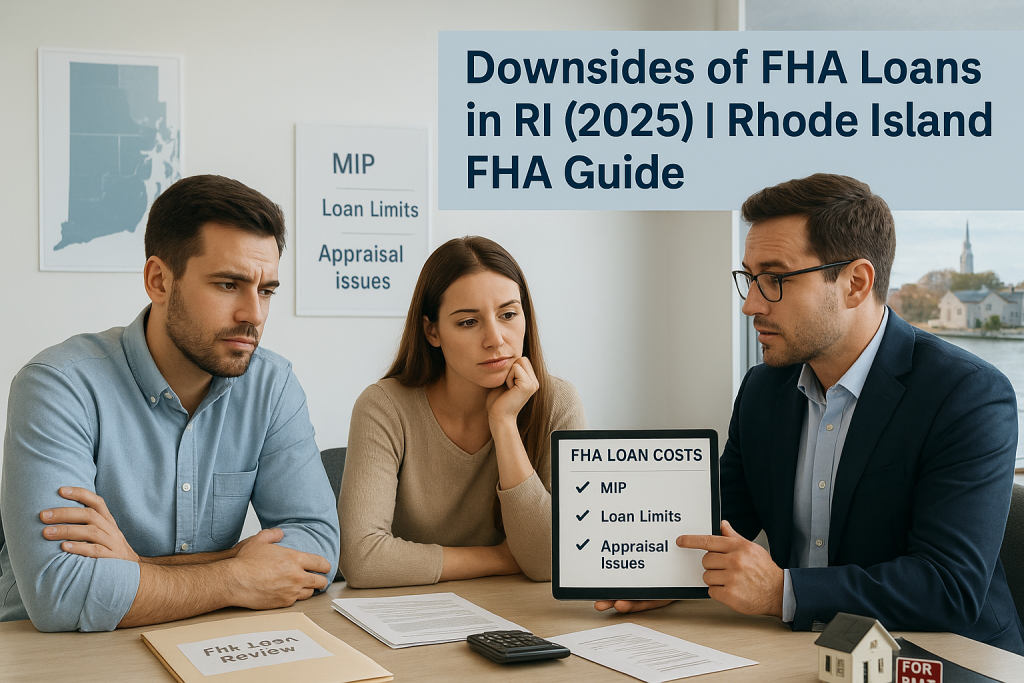
Short solution first: FHA loans help many consumers. Yet the downsides of FHA loans are real. In Rhode Island in 2025, some features that once helped consumers now add value or limit. This manual walks through the most critical drawbacks. It also explains who should keep away from FHA loans in Rhode Island and how to weigh options.
Why is Awareness Of the Downsides of FHA Loans in RI?
First, FHA loans helped many consumers for decades. Yet the loan marketplace has changed. Now, interest charges, alternative programs, and local housing expenses suggest that FHA isn’t continually high-quality. For Rhode Island buyers, area and fees count. Therefore, evaluate the downsides of FHA loans in Rhode Island earlier than you decide.
Mortgage Insurance: a Long-Term Value
One of the biggest downsides of FHA loans in RI is the loan coverage. FHA charges two parts:
- A premature mortgage coverage top rate (UFMIP).
- An annual loan insurance (MIP) is paid monthly.
You can roll the in advance price into the loan. However, that raises your mortgage stability and your interest fee. More importantly, a month-to-month MIP can last a long time. In many FHA loans, MIP remains for 11 years or for the lifestyles of the mortgage. That depends on the down fee and the mortgage term.
For example, a buyer with a small down payment may also pay MIP for the complete 30-year mortgage. Over time, this may feel more than personal mortgage coverage on a conventional loan. Thus, one of the pinnacle downsides of FHA loans in RI is better long-term insurance expenses for some buyers.
FHA Loan Limits Can Be Too Low in Some Areas of Rhode Island
Next, FHA units’ mortgage limits by county. These alternate every 12 months. In a few better-cost Rhode Island cities, FHA loan limits might not cover the cost of ordinary homes.
That forces customers to pick out:
- Move to a lower-cost town
- Use a one-of-a-kind mortgage application
- Put a larger down charge to cover the distance.
Therefore, a 2nd drawback of FHA loans in RI is that loan limits can block purchases in pricier areas. If you plan to shop in Newport or parts of Providence, take a look at the current county FHA limit first.
Property Condition Guidelines Can Block Older or Quirky Homes
FHA calls for the house to meet minimal standards. The home must be safe, sound, and sanitary. Appraisers test heating, roofs, foundations, and utilities. In Rhode Island, many older homes have quirks. Some have knob-and-tube wiring, failing chimneys, or antique septic structures. These objects might also lead the appraiser to flag upkeep.
When upkeep is requested, sellers may refuse to do it. Or the desired fixes may be pricey. That makes FHA a negative fit for fixer-uppers. If the home needs large work, an FHA 203(ok) rehab loan should help. But the 203(okay) is complex and gradual. So, any other drawback of FHA loans in RI is that older houses regularly trigger appraisal restore demands.
Upfront Fees Growth Your Loan Quantity.
As noted, FHA costs an upfront fee. That fee is usually a percentage of the loan. Many consumers roll it into the loan. While rolling the price avoids coins at the final, it increases the most important. For over 30 years, you have paid a hobby at that price. This raises your general cost.
In a quick roll, the upfront charge could make your loan more expensive over the years. That is another drawback of FHA loans in RI for shoppers who’re short on coins, but want to limit long-term charges.
Higher Month-to-Month Bills for Some Debtors
Combining MIP, potentially higher hobby prices, and taxes pushes monthly payments up. Compared to a conventional loan with the same fee but no mortgage coverage or with private mortgage coverage that drops off, your FHA fee can be better.
For customers with first-rate credit and a moderate down payment, a conventional mortgage can cost less monthly. Thus, one more drawback of FHA loans in RI is the capability for better monthly payments for individuals who should use other applications.
Appraisal Delays and Repair Needs Gradual Affect the Purchase.
The FHA appraisal is more than a simple cost take a look at. It inspects the belongings for safety and habitability. If it reveals defects, the underwriting circumstance listing will consist of required repairs. Getting the maintenance accomplished can add days or weeks to the timeline. Sellers could recoil at deciding to buy maintenance. Buyers may not have cash for the paintings.
In busy markets, appraisal and repair delays can kill offers. This is a practical disadvantage of FHA loans in RI: slower closings and more negotiation over upkeep.
Limits on Funding Use and 2nd Homes
FHA loans are for primary residences only. You can not use FHA for natural funding belongings. Also, FHA has guidelines that make buying a 2d home tricky. If your plan includes renting a part of the house or buying funding, FHA isn’t always amazingly healthy. This limit is a disadvantage of FHA loans in RI for shoppers with bendy plans.
Less Gain If You May Place 20% Down
If you can keep a 20% down fee, conventional financing often beats FHA. With 20% down, you keep away from personal mortgage coverage. You can also get lower long-term prices. Therefore, the advantage of FHA (low down payment) will become a drawback if you already have excessive financial savings. In such cases, FHA loans in Rhode Island provide less price.
Mortgage Coverage Regulations Can Block Refinance Financial Savings.
Some buyers plan to refinance later to cast off MIP. That works, but not usually. If residence values fall or if you can’t display equity, refinancing to a conventional mortgage can be difficult. In that case, you continue to be caught with an FHA mortgage coverage. This danger is one of the drawbacks of FHA loans in RI: you can not be capable of getting away from MIP later.
Upfront Supplier Resistance in a Few Markets
Some sellers choose offers sponsored via traditional financing or coins. They fear FHA offers will slow down or fail because of appraisal restore desires. In a competitive Rhode Island marketplace, FHA shoppers may lose bids to be perceived as cleaner. So an oblique disadvantage of FHA loans in RI is lower competitiveness in more than one-provided conditions.
FHA Loan vs Conventional Loan on Common Points
| Topic | FHA Loan (typical) | Conventional Loan (typical) |
| Down payment | 3.5% (possible) | 5%–20% |
| Mortgage insurance | UFMIP + MIP (may last long) | PMI (can be removed) |
| Loan limits | County-based (may be low) | Often higher in high-cost areas |
| Property condition | Strict MPRs | More flexible, depending on the program |
| Refinance path | May be limited by equity | Easier with equity |
| Market competitiveness | Can be weaker in tight markets | Often preferred by sellers |
When FHA Loans Still Make Sense
Even with drawbacks, FHA loans help many consumers. They are healthy whilst:
- You have a small down fee, however a solid earnings.
- Your credit score is fair but not excellent.
- You plan to live in the domestic long-term and accept MIP.
- You purchase in regions where the FHA limits cover charges.
Thus, the downsides of FHA loans in RI need to be weighed in opposition to the information. For some buyers, FHA remains the proper preference.
Local Rhode Island Elements That Change the Equation
Rhode Island has coastal cities, an older housing inventory, and city suburbs. These nearby tendencies affect FHA tradeoffs.
- Coastal and historical homes frequently want updates. That raises MPR troubles.
- Some counties have higher FHA limits than others. Always verify the county limit for your town.
- Titles, attorney prices, and final prices range in Rhode Island—that’s adjustments to cash wishes.
- Local down fee help applications may additionally pair with FHA or with other packages.
Because of these local quirks, the downsides of FHA loans in RI look unique from place to place. Work with a Rhode Island mortgage broker to peer into the neighborhood numbers.
How to Reduce the Impact of The Downsides of FHA Loans
You can take steps to limit the value of FHA downsides.
- Increase your down payment. Even adding some points reduces MIP time in some cases.
- Shop prices and prices. Compare the gains and remaining costs.
- Choose newer or properly-maintained houses. This avoids appraisal restore issues.
- Use the neighborhood down fee resource carefully. Some applications reduce cash at the ultimate and pair nicely with FHA.
- Plan an exit method. Build equity to refinance to standard, whilst feasible.
These steps do not erase the downsides of FHA loans in RI. But they lessen them.
Two Rhode Island Buyers
Emma: First-Time Buyer, Limited Savings
Emma has $8,000 saved. Her credit is fair. She wants to buy in a small Rhode Island town. FHA 203(b) helps her buy now with 3.5% down. She accepts MIP and plans to refinance in five years if values rise. For Emma, FHA outweighs the downsides.
Mark: Buyer with Good Savings and Credit
Mark has $60,000 saved and strong credit. He wants a house in a pricier county. He compares FHA vs conventional. Even with the low down payment, FHA’s MIP makes his monthly cost higher. He chooses conventional and avoids long-term insurance. For Mark, FHA’s downsides are real and costly.
These cases show how the downsides of FHA loans in RI matter differently.
Practical Numbers Example
| Scenario | Home price | Down payment | Loan | MIP/PMI effect | Monthly diff (est) |
| FHA buyer | $350,000 | 3.5% ($12,250) | $350k + UFMIP | MIP adds $80–$150/mo | +$120/mo vs conventional |
| Conventional buyer | $350,000 | 20% ($70,000) | $280,000 | No PMI | baseline |
Note: These are sample numbers. Exact costs vary by rate and region. Use FHA Loan broker to run real estimates for your Rhode Island town.
Common Myths About FHA Loans
| Myths | Fact |
| The FHA loans always cost less. | FHA often has lower entry costs but can cost more over time due to MIP. |
| FHA is the only option for low-credit buyers. | Other programs, state help, or co-borrower options may be competitive. |
| FHA loans are fast and easy. | Appraisal and MPR rules can slow some FHA transactions. |
Understanding these helps you weigh the downsides of FHA loans in RI wisely.
Final Thoughts
In 2025, FHA loans in Rhode Island will still open doors. Yet the downsides of FHA loans in RI are real. They include long-term mortgage insurance, county loan limits, appraisal hurdles, and possibly higher monthly costs. Each buyer must compare programs and local numbers.
If you want a clear, local analysis for your situation, we can help. Our Rhode Island Mortgage Brokers team runs the exact math for your town. We check FHA limits, explain MIP impact, and show alternatives.
FAQs
Is FHA always bad in Rhode Island?
No. It helps many buyers. But the downsides mean it is not best for everyone.
Can I avoid MIP on an FHA loan?
Often not. MIP rules depend on down payment and loan term. Check details with a broker.
What if a home fails an FHA appraisal?
You can ask the seller to repair, negotiate a lower price, or choose a different loan program.
Do FHA limits change?
Yes. FHA limits update yearly and vary by county.
