
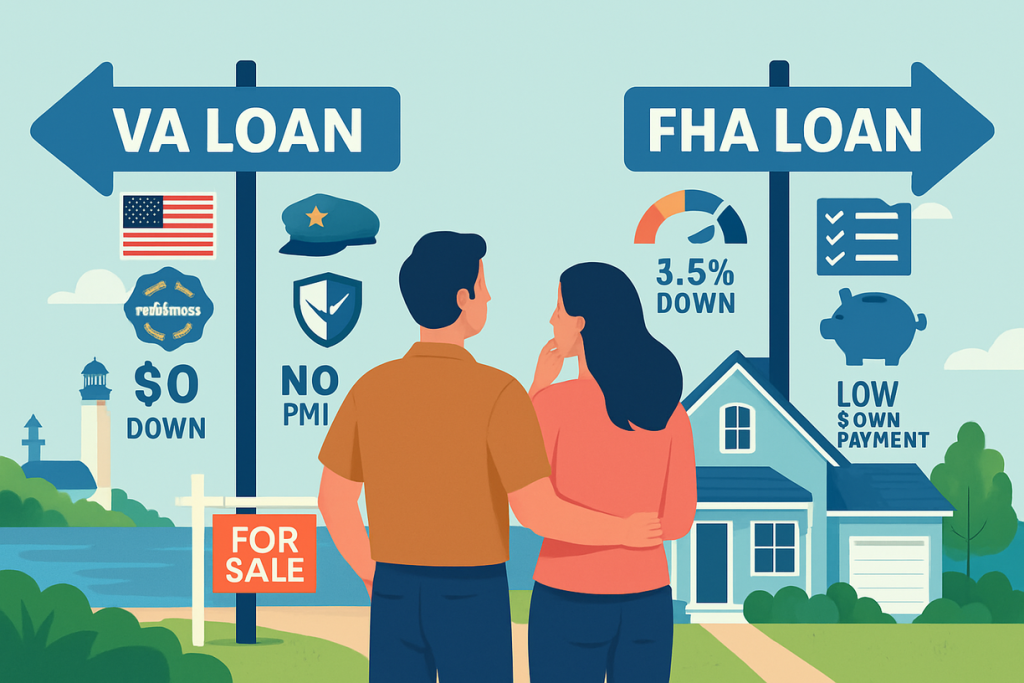
Buying a home in Rhode Island is exciting. However, it can also be stressful. One of the biggest choices is your loan type. RI Home buyers often compare VA loan and FHA.
These two loans are both backed by the government. Yet, they are designed for very different borrowers. VA loans help veterans, active-duty service members, and some surviving spouses. FHA loans help a wider range of buyers, especially first-time homebuyers or those with lower credit scores.
In 2025, RI’s housing market will remain competitive. Home prices are rising in many areas. Mortgage rates are also slightly higher than they were a few years ago. Therefore, choosing the right loan is critical.
If you’re new to FHA loans, you might want to read this first: What Is an FHA Loan and How Does It Work in 2025 Rhode Island?
FHA Loans in Rhode Island – What You Need to Know
The Federal Housing Administration backs FHA loans. Therefore, they carry the security of a government guarantee. They are also one of the most popular options for homebuyers in Rhode Island.
-
Who They Help the Most
They’re a great choice for first-time buyers. In addition, they work well for people with lower credit scores. Moreover, they are helpful for buyers who do not have large savings for a down payment.
Because of these features, FHA loans open doors for many who might struggle with conventional loans. As a result, they have become a lifeline for many Rhode Island families.
-
Why They Matter in Rhode Island
In Rhode Island, FHA loans are helping many buyers who might otherwise be priced out of the market. Why? Home prices here have been steadily rising year after year.
According to RI housing data for 2025, the median single-family home price is around $430,000. Meanwhile, the median condo price is about $350,000. These numbers can make saving for a traditional down payment very challenging.
-
FHA Loan Limits for 2025
Fortunately, FHA loans have generous limits that fit many local properties. The 2025 FHA loan limits in Rhode Island are:
- Single-family homes: $498,257
- Two-unit properties: $637,950
- Three-unit properties: $771,125
- Four-unit properties: $958,350
These limits mean you can consider a variety of property types. Therefore, whether you’re buying a starter home or a multi-unit property, FHA might still be an option.
If you want more details on these limits, see: What is the FHA loan limit in Rhode Island?
-
Low Down Payment Advantage
The biggest appeal is the low down payment requirement. You can buy with just 3.5% down if your credit score is 580 or higher. For example, that’s only $15,050 on a $430,000 home.
Even if your credit score is lower—down to 500—you might still qualify. In that case, you would need a 10% down payment. That’s still often less than what a conventional loan might require.
Because of these options, FHA loans remain one of the most accessible mortgage programs in Rhode Island. In fact, many buyers find they can enter the market years sooner with FHA financing.
VA Loans in Rhode Island – A Quick Overview
The U.S. Department of Veterans Affairs backs VA loans. Therefore, they carry the strength and trust of a federal program. They are designed specifically for eligible veterans, active-duty service members, and certain surviving spouses.
-
Who They Are For
The program exists to honor and support those who have served. As a result, it removes some of the biggest barriers to homeownership.
The standout benefit? No down payment is required for most borrowers. It is a huge deal in Rhode Island. Why? Because saving for a traditional down payment here can take many years.
For example, consider a $400,000 home. A conventional loan with 20% down needs $80,000 upfront. However, with a VA loan, you can move in with $0 down.
-
Key Benefits That Stand Out
In addition to no down payment, VA loans offer several other major advantages:
- No private mortgage insurance (PMI) – ever.
- Competitive interest rates that often beat conventional and FHA rates.
- Flexible credit requirements that make it easier to qualify.
Moreover, closing costs are often lower. In some cases, sellers can even pay part of those costs for you.
-
Why VA Loans Matter in Rhode Island
Here’s something unique to Rhode Island: the state has a large veteran community. Therefore, VA loans are not just a niche option here. Instead, they are a major part of our housing market.
Plus, with home prices still climbing, being able to buy with zero down gives veterans a serious affordability edge. It allows them to buy sooner. It also lets them keep their savings for moving costs, furniture, or emergencies.
In short, VA loans give Rhode Island veterans and service members a faster, easier, and more affordable path to homeownership.
VA Loan vs FHA Loan: Side-by-Side Comparison
Feature |
VA Loan |
FHA Loan |
| Eligibility | Exclusively for veterans, active-duty service members, and eligible spouses | Available to all borrowers (first-time and repeat buyers) |
| Down Payment | No down payment required | As low as 3.5% |
| Credit Score | Flexible – often 620+ (some lenders go lower) | More lenient – minimum 580 for 3.5% down |
| Mortgage Insurance | No monthly PMI; only a one-time VA funding fee (can be waived for disabled vets) | Requires upfront and annual mortgage insurance premiums (MIP) |
| Interest Rates | Typically lower than FHA due to VA backing | Slightly higher than VA loans |
| Property Type | Must be a primary residence | Can be primary, some condos, or multi-family (with restrictions) |
| Closing Costs | Limited by VA; sellers can cover many expenses | Standard closing costs (cannot be waived) |
| Best For | Veterans/military buyers seeking $0 down and long-term savings | Buyers with limited credit or savings needing easier approval |
Eligibility – FHA vs. VA in Rhode Island
The eligibility rules are not the same. In fact, they are very different. Therefore, it is important to understand each before deciding.
-
Who Can Get an FHA Loan in Rhode Island
FHA loans are open to most people who meet credit and income guidelines. Moreover, you do not have to be a first-time buyer. Many repeat buyers also use FHA financing. Why? Because the requirements are more flexible than many conventional loans.
For instance, if your credit score is lower, FHA can still work. Likewise, if your down payment savings are small, FHA is often an option. In addition, FHA loans can be helpful if you have had credit issues in the past.
If you want more details on this, see: What is an FHA loan and who qualifies?
-
Who Can Get a VA Loan in Rhode Island
VA loans require military service. Therefore, not everyone qualifies. You need a Certificate of Eligibility (COE) from the U.S. Department of Veterans Affairs.
Service length requirements vary. For example, active-duty members may qualify after 90 continuous days of service. Veterans with prior service have other requirements. In addition, members of the National Guard and Reserves may qualify after specific service periods. Some surviving spouses of service members can also be eligible.
-
If You Qualify for Both
If you are eligible for both FHA and VA, then you have more options to compare. In fact, you can review both programs side-by-side. It allows you to weigh down payment needs, monthly costs, and long-term savings. Consequently, you can choose the loan that best fits your personal and financial goals.
Down Payment Showdown – FHA vs. VA
Here’s where the difference hits your wallet.
- FHA loans: Minimum 3.5% down with a credit score of 580 or higher. That’s $8,750 on a $250,000 home. If your score is between 500–579, you’ll need 10% down, or $25,000.
- VA loans: No down payment for most borrowers. That means you could buy that same $250,000 home with $0 down.
If you want a deeper dive on FHA down payments, see: What would the minimum down payment be for an FHA loan of $250,000?
It is one of the reasons many veterans find VA loans unbeatable—they can keep their savings for moving costs, renovations, or emergencies.
Mortgage Insurance and Loan Costs
Another big cost factor is mortgage insurance.
FHA loans require two types:
- Upfront Mortgage Insurance Premium (MIP): 1.75% of the loan amount (can be rolled into the loan).
- Annual MIP: Paid monthly, based on your loan balance and down payment.
VA loans don’t have MIP. Instead, there’s a VA funding fee—a one-time cost that ranges from 1.25% to 3.3%, depending on your service history and whether it’s your first VA loan. Some borrowers (like those with service-connected disabilities) are exempt.
For more on VA’s downsides, read: What is the downside of an VA loan?
Loan Limits – FHA vs. VA in RI
Loan limits also shape your options. In fact, they can be a major deciding factor when choosing between FHA and VA financing. Therefore, it’s important to understand how each program sets its limits.
-
FHA Loan Limits in Rhode Island
FHA loans are capped based on county-specific limits. As mentioned earlier, Rhode Island’s 2025 limits work for most buyers. However, they can feel restrictive for high-end or luxury properties.
For example, if you want to buy a single-family home priced well above the FHA limit, you would need to make a larger down payment to cover the difference. In addition, multi-unit buyers may hit the cap if they are looking in higher-priced areas.
If you want to see all the numbers and details, check: What is the FHA loan limit in Rhode Island?
-
VA Loan Limits in Rhode Island
VA loans are different. Technically, there is no official loan limit for eligible borrowers. It means that if you qualify, you can finance higher-priced homes without worrying about a strict federal cap.
However, there’s a small but important detail. While the VA sets no hard limit, brokers may still impose practical limits based on your income, credit profile, and overall financial situation. Therefore, even with VA’s flexibility, your approved amount will depend on what a broker believes you can afford.
Which Loan Is “Better” for RI Buyers?
If you’re eligible for a VA loan, it’s usually the stronger financial choice. No down payment, no MIP, and often lower rates mean lower monthly payments and faster equity growth.
However, if you’re not eligible, FHA is still one of the most accessible programs out there. It opens the door to homeownership for buyers who might not qualify elsewhere.
The “better” loan really comes down to your eligibility and your long-term financial goals.
When FHA Might Win in Rhode Island
There are a few scenarios where FHA could be the better fit—even if you’re eligible for VA:
- You’re buying a multi-unit property, and FHA rules are a better match for your situation.
- The VA funding fee would be higher than the FHA’s upfront costs for your scenario.
- You want to keep VA eligibility for a future purchase in a different market.
Why Work With a Local RI Mortgage Broker
Comparing VA and FHA loans is tricky without looking at your full financial picture. That’s where RI Mortgage Brokers can help.
They work with both FHA and VA brokers so that they can show you real numbers side-by-side. Plus, they know the Rhode Island housing market inside out, which means they can match you with the right program faster.
Conclusion – Your Next Step
In Rhode Island’s 2025 market, a VA loan is usually better if you’re eligible. But FHA loans are an essential lifeline for buyers who don’t meet VA’s service requirements.
The smartest move? Talk to a local expert. RI Mortgage Brokers can give you a free VA vs. FHA comparison so you can make an informed choice.
FAQs
1. Can I switch from an FHA loan to a VA loan later?
Yes—if you become eligible for a VA loan later, you can refinance an FHA loan into a VA to remove mortgage insurance and potentially lower your payments.
2. Are VA loan rates always lower than FHA rates?
Not always, but VA loans often have a slight edge. Rates depend on the broker, market conditions, and your credit profile.
3. Does RI have special incentives for veterans buying a home?
Yes. In addition to VA loans, some Rhode Island cities offer property tax discounts or closing cost assistance for veterans.