
Are VA loans really easier to qualify for? That’s the question many Rhode Island veterans ask when they start thinking about buying a home. The truth is, VA loan approval has some advantages compared to conventional financing, but it also comes with unique rules.
Rhode Island is home to thousands of veterans and active-duty service members. For many of them, homeownership becomes a real possibility through VA financing. Programs like these were created to make buying a home more accessible for those who served.
When we ask if VA loans are easier to get approved, we’re really asking how they compare to conventional loans in areas like credit scores, income, debt, and down payments. RI Mortgage Brokers helps local veterans navigate these questions every day.
If you want to go deeper into the basics of VA financing, check out: What is a VA Loan? Everything Rhode Island Veterans Need to Know (2025).
What “Easier to Get Approved” Really Means
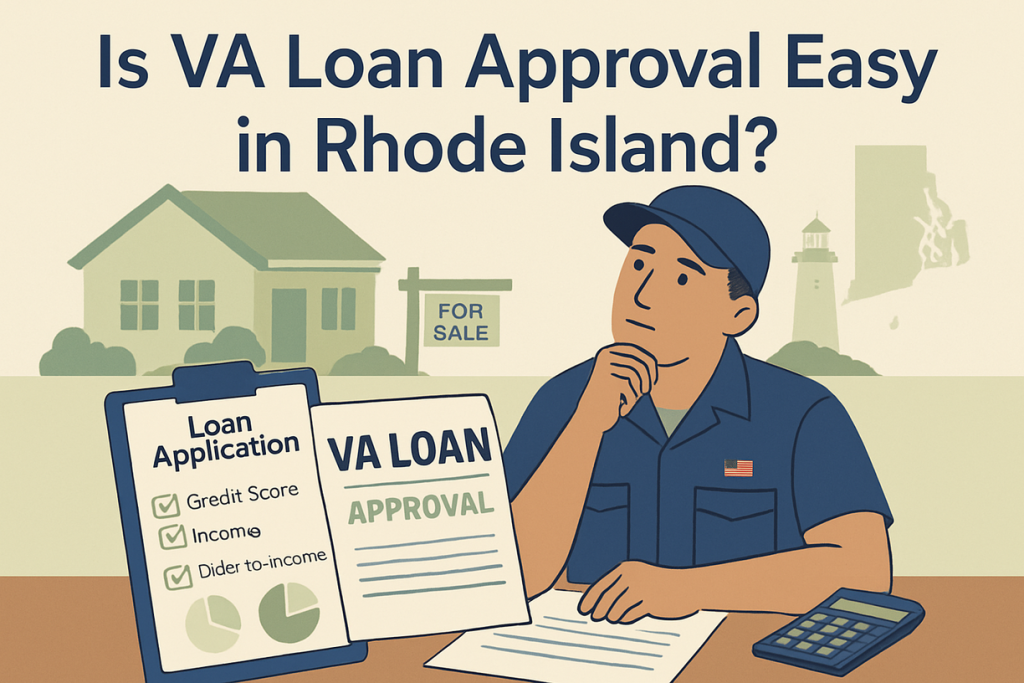
Approval doesn’t just mean a simple yes or no from the bank. Instead, it’s about meeting a checklist of criteria that brokers use to decide if you qualify. For VA loan approval, the biggest factors come down to a few key areas. Let’s walk through each one.
-
Credit Score
Here’s the first thing brokers look at—your credit score. Conventional loans usually require a much higher number, often 640 or more. VA loans, however, give veterans a wider path. Many brokers will approve with scores as low as 580–620. This flexibility means more veterans can qualify sooner instead of waiting years to rebuild credit.
-
Income Stability
Next comes income. Brokers want to see that your paycheck is steady and reliable. Conventional loans often demand long work histories or high salaries to feel secure. But with a VA loan approval, the standard is more forgiving. As long as you can show consistent employment or steady service-related income, you’re in a stronger position.
-
Debt-to-Income Ratio (DTI)
Another major factor is DTI. It compares what you earn each month against what you owe. Conventional programs usually cap you at 36–43%. That can be tough if you carry student loans, car payments, or credit card balances. The VA allows DTIs up to 41% as a guideline—and in many cases, even higher if other strengths are present. Bottom line? Veterans have more room to qualify.
-
Property Requirements
Finally, the property itself must pass certain standards. It is where VA approval adds one extra step. Homes must be safe, structurally sound, and move-in ready. Conventional loans often pass homes with more issues, but the VA protects veterans by avoiding risky properties. Yes, it can feel like a hurdle. But in reality, it ensures you’re buying a solid investment, not a financial burden.
Here’s the thing, conventional loans tend to have stricter minimums across these categories. VA loans, on the other hand, were designed to give veterans a break by loosening some of these barriers.
Let’s break it down further and compare. Conventional brokers usually want higher credit scores, larger savings for down payments, and lower DTIs. Veterans applying for VA financing often find these standards less demanding, which means approval odds are stronger.
VA Loan Credit Requirements in Rhode Island
A credit score is always one of the first questions borrowers ask. The VA itself does not set a hard minimum. Still, most brokers look for something in the 580–620 range to move forward with VA loan approval. That’s a big difference compared to other loan types. Let’s break it down further.
-
Lower Minimums Compared to Conventional Loans
Conventional brokers usually want higher scores, often starting at 640 or even more. That creates a barrier for many Rhode Island buyers. But VA loans lower that wall. With a score in the high 500s or low 600s, veterans often qualify. It means you don’t always need perfect credit to become a homeowner. And that’s a huge relief for many families.
-
Flexibility That Opens Doors
Here’s the thing—flexibility matters. Many veterans in Rhode Island have fair credit but strong, steady income. Conventional brokers might still say no. VA programs, on the other hand, balance the whole picture. If income is solid and debt is manageable, approval is still within reach. It makes VA financing feel less like a distant dream and more like a real opportunity.
-
Easier Than Jumbo and High-Risk Loans
Now let’s compare again. Jumbo loans and other higher-risk programs usually require scores over 700. That number locks out a large portion of borrowers. Veterans, however, don’t face that same wall. VA loans give them a realistic path, even when other products are out of reach. And that difference can mean years saved from trying to rebuild credit.
For more details, check out: How Does a VA Loan Work?.
Income and Debt-to-Income Ratios (DTI)
When it comes to VA loan approval, income and debt are just as important as credit. Brokers want to see how much of your monthly earnings are already committed to obligations. It is where the debt-to-income ratio (DTI) comes in. The VA guideline usually sits at 41%. However, the story doesn’t end there. With strong compensating factors, such as steady savings, a second household income, or a history of managing payments well, many brokers can stretch approvals up to 50%. That kind of flexibility is a game-changer for a lot of Rhode Island veterans.
-
Why VA Guidelines Are More Flexible Than Conventional Loans
Here’s the thing: conventional financing tends to be much stricter. Most conventional programs set their DTI limits between 36% and 43%. That might sound close on paper, but in practice, it makes a huge difference. For veterans with student loans, car payments, or medical bills, those numbers can shut down the path to homeownership quickly.
VA loans, on the other hand, were built to recognize the realities of life. They allow more room to breathe and more opportunities to qualify, even when your monthly obligations take up a bigger slice of your paycheck.
-
Rhode Island Example: How Income Translates to Buying Power
Let’s break this down with a real Rhode Island scenario. The median household income here is about $85,000. With VA loan guidelines, that income can stretch far enough to support buying a home in the $350,000 to $400,000 range, even while carrying normal debts like a car payment or credit card balance. With conventional lending rules, that same family might not even qualify for the higher end of that range. The difference is clear.
VA loan approval often puts a home within reach for families who would otherwise be left on the sidelines.
If you’d like a deeper dive, see: How Much Do I Need to Make to Buy a $400K House with a VA Loan?.
Down Payment Flexibility Makes Approval Easier
For many borrowers, the hardest part of qualifying for a mortgage is saving for the down payment. It is where VA loans change the game. They require zero down payment.
Think about it. On a $350,000 Rhode Island home, a conventional 20% down payment equals $70,000 upfront. Even a 5% down payment still means coming up with $17,500. Many first-time buyers don’t have that kind of cash.
With a VA loan, you don’t need to bring anything close to that. It makes the approval process smoother since brokers don’t have to worry about whether you’ve saved enough. Veterans can enter the housing market much faster, with fewer financial barriers.
Want to explore more? See: Does a VA Loan Require 20% Down?
Property Standards: An Extra Layer in Approval
While credit and income are often easier to qualify for, VA loan approval comes with one more step—the property appraisal. VA appraisers look at whether the home is safe, structurally sound, and sanitary.
It means certain homes may not pass, especially older properties in Rhode Island with issues like outdated wiring or roof damage. While this can feel like a hurdle, it’s also protection. Veterans deserve homes that are safe investments, not money pits.
So while VA loans may ease financial requirements, property standards can make approval a little more complex.
Learn more in: What is the Downside of a VA Loan?
Rhode Island Example: Conventional vs. VA Loan Approval Odds
Let’s walk through a real-world example.
A veteran in Rhode Island has a 620 credit score, stable income, and $5,000 in savings. They want to buy a $350,000 home.
- VA Loan: Approved with no down payment, flexible credit, and a manageable DTI.
- Conventional Loan: Likely denied because the credit score is below 640, savings aren’t enough for the down payment, and DTI might be too high.
Now compare this to a civilian borrower with the same profile. Without access to VA benefits, their options are limited to FHA or other government-backed programs, which still require a down payment and mortgage insurance.
This example shows how VA loan approval can be the difference between buying a home now and waiting years to qualify.
Are VA Loans Easier to Get Approved in Rhode Island?
So what’s the balanced answer? Yes, VA loans are generally easier to get approved for if you’re eligible. Credit score flexibility, $0 down payments, and higher DTI allowances make them more accessible than most alternatives.
But they aren’t automatic approvals. Veterans must still meet service eligibility requirements, show stable income, and choose properties that meet VA standards.
The bottom line? For Rhode Island veterans, VA loan approval is usually the smoothest path to homeownership. With the right guidance, it becomes even simpler. That’s where Mortgage Brokers can make a difference—by navigating the process, removing roadblocks, and increasing your chances of success.
Conclusion: Your Path to VA Loan Approval in Rhode Island
Let’s recap. VA loans remove the biggest barriers to mortgage approval: strict credit requirements, high down payments, and tight income rules. While property standards add a layer of review, they protect veterans in the long run.
For eligible Rhode Island veterans, VA loan approval is often the easiest and most cost-effective way into homeownership.
If you’re ready to explore your options, connect with RI Mortgage Brokers. We specialize in VA loans and know the Rhode Island market inside and out. The approval process doesn’t have to feel overwhelming—especially when you have experts on your side.
FAQs
Can I use a VA loan more than once in Rhode Island?
Yes, you can. VA loans come with a feature called entitlement restoration. It means if you sell your home or pay off your VA loan, you may use your benefit again. Many veterans in Rhode Island use VA financing more than once.
Do VA loans in Rhode Island have prepayment penalties?
No. VA loans never include prepayment penalties. That means you can pay off your loan early, refinance when rates drop, or make extra payments without worrying about fees or restrictions.
Can I buy a multi-family property with a VA loan?
Yes, as long as you plan to live in one of the units. In Rhode Island, veterans often use VA loans to purchase duplexes or triplexes, combining homeownership with rental income.