
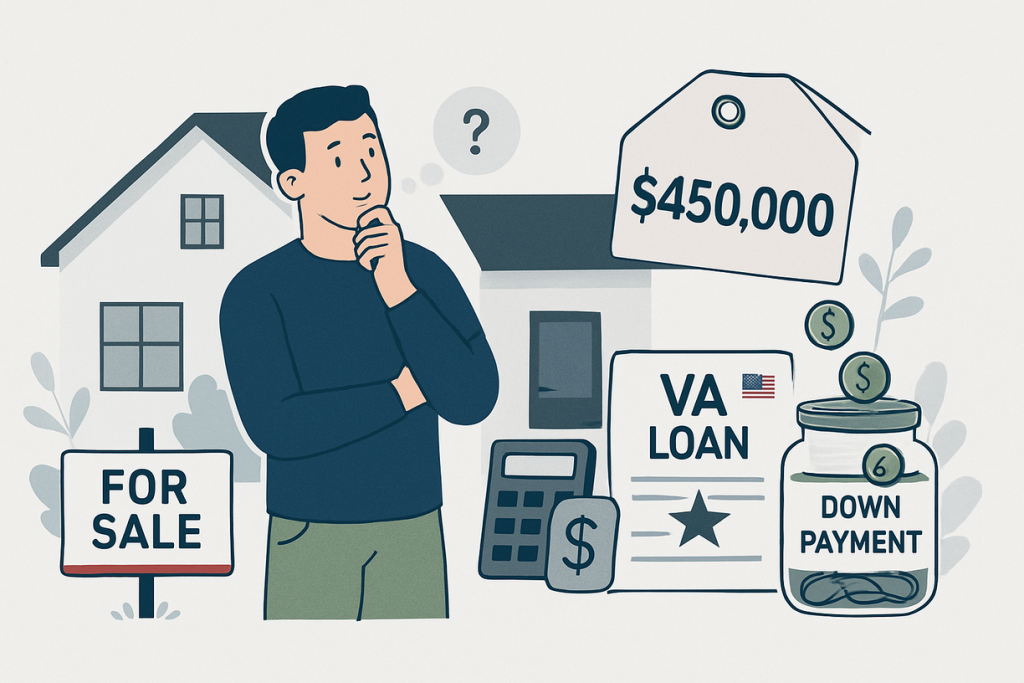
Buying a home in Rhode Island is exciting, but it also raises financial questions. Veterans, active-duty service members, and eligible spouses often ask the same thing: What would be the minimum down payment on a VA loan of $450,000?
This question comes up a lot because housing costs are not cheap. In places like Providence, Warwick, and Cranston, home prices have steadily risen in the last few years. For many buyers, $450,000 is a very realistic purchase price. But the thought of a huge down payment can feel overwhelming. That’s where VA loans make a major difference.
So, let’s take a closer look. We’ll break down how VA loans work, when a down payment is required, and how RI Mortgage Brokers can guide you through every step. By the end, you’ll clearly understand whether a $450,000 VA loan in Rhode Island needs any upfront cash.
Related Reading: What is a VA Loan? Everything Rhode Island Veterans Need to Know (2025)
Standard VA Loan Rule: $0 Down Payment
The very first thing you need to know is simple: the minimum down payment on a VA loan is usually zero. Yes, you read that correctly. Unlike conventional or FHA mortgages, VA loans do not require you to put thousands of dollars down before moving into your new home.
-
Why $0 Down Is a Game-Changer
Now, let’s think about what this really means. Most homebuyers in Rhode Island must save for years to gather a down payment. For many families, this feels like the biggest barrier to buying a home. However, VA buyers get to skip that step entirely.
For example, on a $450,000 home, conventional buyers may need to bring $22,500 to $90,000 to the table. FHA buyers need at least $15,750. But with a VA loan, the minimum down payment on a VA loan is still zero. That is a massive difference and an immediate relief for buyers.
-
More Than Just Upfront Savings
But here’s the best part—VA loans not only reduce upfront costs, they also protect your monthly budget. How? By removing private mortgage insurance (PMI). Both FHA and conventional loans require this extra monthly cost unless you make a large down payment. VA loans eliminate it.
As a result, buyers enjoy a double win. On one hand, they save tens of thousands upfront. On the other hand, they keep monthly payments significantly lower. It makes long-term homeownership much more affordable.
Related Reading: Does a VA Loan Require 20% Down?
VA Loan Limits in Rhode Island (2025 Update)
Now, are there limits? The answer is yes—but those limits are generous, especially for Rhode Island buyers.
-
2025 VA Loan Limit in Rhode Island
For 2025, the conforming VA loan limit across Rhode Island counties is $766,550. And here’s the good news: since a $450,000 home is comfortably below that limit, the minimum down payment on a VA loan in this case is still zero. In other words, you don’t have to worry about bringing tens of thousands in cash to the table.
-
How VA Loans Differ from Other Programs
But let’s dig deeper. With FHA or conventional loans, the higher the purchase price, the more you are forced to put down. For example, a $450,000 FHA loan requires at least 3.5%, which equals $15,750 upfront. Conventional buyers may need $22,500 to $90,000, depending on their down payment percentage.
By contrast, VA loans stand apart. As long as you stay under the county loan limit and you still have your entitlement available, the minimum down payment on a VA loan remains zero. That single rule saves Rhode Island veterans thousands of dollars.
-
Local Guidance for Rhode Island Buyers
And here’s where experience matters. RI Mortgage Brokers regularly helps veterans in Providence, Warwick, and Cranston navigate these VA loan limits with confidence. We make sure every buyer understands exactly how much they can borrow without worrying about unexpected down payment requirements. As a result, you stay focused on your home search—not stressing about upfront costs.
Related Reading: How Does a VA Loan Work?
Situations Where a Down Payment May Be Required
Although the standard rule is $0 down, there are certain situations where the minimum down payment on a VA loan may come into play. And while these cases are not common, they are important to understand before starting your home search. So, let’s carefully walk through them, one by one, and see exactly how they might affect Rhode Island buyers.
-
Reduced Entitlement
First of all, reduced entitlement is a major factor. If you’ve already used your VA loan benefit in the past and haven’t fully restored it, then you may be required to contribute a down payment. For example, imagine you purchased a home several years ago with a VA loan and decided to keep it as a rental.
Now, as you look for another home, your entitlement is only partially available. Because of this, you might need to put some money down to bridge the gap. In this case, the minimum down payment on a VA loan isn’t zero, but rather a partial amount tied directly to how much entitlement you have left.
-
Exceeding the Loan Limit
Next, consider what happens if you buy a home that exceeds the loan limit. In Rhode Island, the 2025 VA loan limit is set at $766,550. So, if you stay at or below that number, like when buying a $450,000 home, no down payment is needed. However, if you decide to purchase something above that limit, such as a $900,000 home in Newport, then you will be required to pay a portion of the difference.
That’s when the minimum down payment on a VA loan becomes necessary. In other words, VA financing remains generous, but jumbo-size purchases may trigger a partial down payment requirement.
-
Credit or Broker Overlays
In addition, credit score and lender-specific rules may sometimes create exceptions. Even though VA guidelines themselves do not mandate a down payment, some lenders add their own overlays.
For instance, if your credit score is lower than their comfort level, or if your income documentation doesn’t fit standard expectations, the lender may ask for a small down payment to offset the risk. These cases are rare, but they do happen.
-
Real-World Example
Let’s look at a quick scenario to make this clearer. Imagine a veteran buying an $850,000 property in Bristol. Because the purchase price goes beyond the county loan limit, the buyer must contribute a percentage of the difference between the home price and the VA cap.
In this situation, the minimum down payment on a VA loan becomes part of the transaction. The good news, though, is that this amount is still usually far less than what a conventional or FHA borrower would need to pay upfront.
Comparing VA vs. Conventional or FHA Down Payments
It’s easier to see the savings when you compare VA loans side by side with other programs.
Loan Type |
Down Payment on $450k |
Other Costs |
Impact on Buyers |
| VA Loan | $0 | No PMI | Lowest upfront and monthly cost |
| FHA Loan | 15,750 (3.5%) | PMI required | Higher monthly payments |
| Conventional Loan | $22,500–$90,000 (5–20%) | PMI if <20% | Major upfront savings required |
With these numbers, the VA loan advantage is clear. On a $450,000 home, an FHA buyer needs nearly $16,000 upfront. A conventional buyer may need $90,000 to avoid PMI. But the minimum down payment on a VA loan is zero. That’s why RI Mortgage Brokers consistently sees veterans compete more strongly in Rhode Island’s housing market.
Related Reading: What is the Downside of a VA Loan?
Example: $450K VA Loan in Rhode Island with No Down Payment
Let’s bring this to life with a practical example. Suppose a veteran wants to buy a $450,000 home in Warwick using a VA loan. Here’s how the monthly costs could look:
- Principal & Interest: Around $2,200–$2,400 at current VA rates.
- Property Taxes: About $5,800 annually in Rhode Island, or around $480 monthly.
- Homeowners Insurance: Roughly $120–$150 per month.
- HOA Fees: $0 for single-family homes, $150–$300 for condos.
Altogether, the monthly payment may land between $2,800 and $3,100. That is still manageable for many households earning around $100,000 to $120,000 annually.
Compare this to an FHA buyer who would need $15,750 upfront and higher insurance costs each month. Once again, the minimum down payment on a VA loan shows its strength—it keeps your savings available for other needs.
Related Reading: How Much Do I Need to Make to Buy a $400K House with a VA Loan?
Benefits of $0 Down on a $450K Home in Rhode Island
Now, let’s go beyond the numbers. What are the real-life benefits of skipping the down payment?
-
Keep More Cash in Your Pocket
Moving is expensive. There are closing costs, furniture, repairs, and even unexpected bills. When the minimum down payment on a VA loan is zero, you keep your savings for these expenses.
-
Stronger Buying Power
Rhode Island’s housing market is competitive. Sellers prefer buyers who can close quickly. By not draining your savings into a down payment, you remain flexible and attractive to sellers.
-
Less Financial Stress
Buying a home should be exciting, not overwhelming. A VA loan reduces upfront costs, which lowers stress and makes the process smoother.
RI Mortgage Brokers often reminds veterans that saving money up front can also mean investing more into their future. Whether that’s retirement accounts, home improvements, or an emergency fund, the VA loan advantage gives you options.
Tips for Rhode Island Veterans Considering a $450K VA Loan
Even with $0 down, it’s smart to plan. Here are some expert tips:
- Get Pre-Approved: Knowing your exact budget gives you confidence when house shopping.
- Check Your Entitlement: Make sure you have full VA entitlement before making offers.
- Shop Around: RI Mortgage Brokers compares VA-approved lenders across Rhode Island to secure the best rates.
- Ask About Seller Concessions: VA rules allow sellers to cover some closing costs. This can save thousands.
- Explore Different Areas: Towns outside Providence often have lower property taxes and better value.
By following these steps, veterans can maximize the benefits of a $450,000 VA loan while keeping costs as low as possible.
Conclusion: Do You Need a Down Payment on a $450K VA Loan?
So, let’s return to the big question: What would be the minimum down payment on a VA loan of $450,000?
For most Rhode Island buyers, the answer is simple—zero. As long as you stay under the county loan limit and have full entitlement, no down payment is required. You avoid PMI, enjoy competitive interest rates, and keep your savings intact.
However, remember that exceptions exist. If your entitlement is reduced, or if you buy above $766,550, you may face a partial down payment. That’s why pre-approval matters.
With RI Mortgage Brokers, veterans gain more than just a loan officer. You get a trusted local partner who understands the Rhode Island market and VA loan benefits inside and out. We make sure you know every number, every option, and every way to save.
FAQs
Do VA loans always require a down payment?
No, VA loans typically require no upfront cash. In fact, the minimum down payment on a VA loan is usually zero, unless entitlement is reduced or the purchase exceeds county loan limits, making it far more affordable.
When might I need a down payment on a VA loan?
The minimum down payment on a VA loan may apply if you’ve used part of your entitlement, are buying above loan limits, or face unique lender requirements. In most cases, however, Rhode Island veterans still qualify for $0 down.
How does a VA loan compare to FHA or Conventional down payments?
The minimum down payment on a VA loan is zero, but FHA requires 3.5% and Conventional loans often need 5–20%. That means VA borrowers can save tens of thousands upfront while enjoying lower long-term housing costs overall.
