
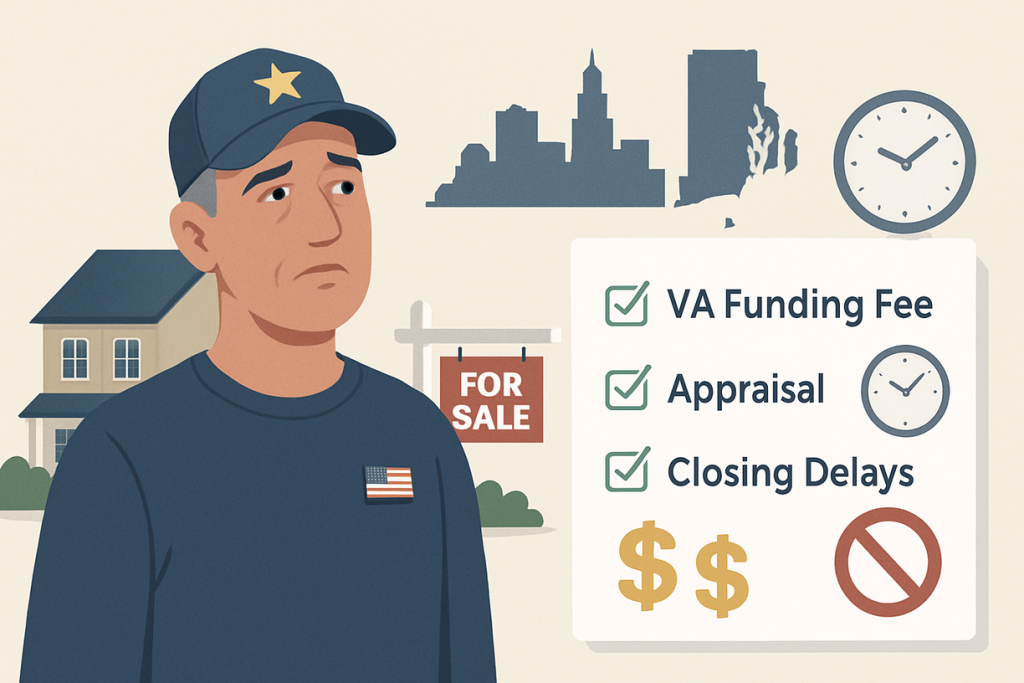
Buying a home in Rhode Island is exciting, especially for veterans and active-duty service members who can use a VA loan. VA loans are one of the most powerful benefits offered to those who served. They allow buyers to purchase with no down payment, lower credit requirements, and competitive interest rates. However, every loan has trade-offs. While VA loans are incredibly helpful, they also come with certain drawbacks. Knowing the disadvantages of a VA loan is important.
Why? Understanding both the benefits and the limitations helps you make smarter choices before buying your dream home in Rhode Island.
In this blog, we’ll explore the key disadvantages of a VA loan, using Rhode Island examples and real-world scenarios. This way, you’ll know what to expect and how to prepare.
If you want to dive deeper into the basics, check out our main guide:
What is a VA Loan? Everything Rhode Island Veterans Need to Know (2025).
Let’s break it down.
VA Funding Fee – The Hidden Upfront Cost
One of the most common disadvantages of a VA loan is the funding fee. In fact, this one-time cost often surprises many first-time buyers. The VA funding fee is a one-time payment that helps sustain the VA loan program. Moreover, it applies to most borrowers unless you’re exempt.
-
How Much Is the VA Funding Fee?
For first-time VA loan users in 2025, the funding fee is 2.3% of the loan amount. However, for subsequent uses, it jumps to 3.6%. That difference may not seem huge at first, but in reality, it can be a big number.
For example, let’s look at a Rhode Island scenario. Imagine you’re buying a $400,000 home in Warwick. If it’s your first VA loan, the funding fee will be $9,200. On the other hand, if it’s your second use, it jumps to $14,400. Clearly, that’s not pocket change.
-
Who Is Exempt and Why It Matters
The good news is that some veterans are exempt. Specifically, disabled veterans receiving VA compensation and certain surviving spouses don’t have to pay this fee. Therefore, they save thousands of dollars upfront.
But for most buyers, this cost—whether paid upfront or rolled into the loan—is a real consideration. Yes, rolling it into your loan may feel easier. However, it increases your monthly payments. And as a result, your long-term budget may feel tighter. That’s why, in the end, the VA funding fee is often considered one of the biggest disadvantages of a VA loan.
Property Restrictions with VA Loans
Another one of the disadvantages of a VA loan is property restrictions. VA loans require an appraisal, and that appraisal must meet the VA’s Minimum Property Requirements (MPRs). These rules exist to ensure the property is safe, sound, and sanitary.
At first, this sounds great for buyers. However, it can create serious issues in Rhode Island. Many homes here are older, especially along the coast. As a result, they may have structural concerns, outdated electrical systems, or even flood-zone risks. Meeting MPRs in these cases can lead to delays, added repairs, or, in the worst cases, cancelled deals.
Moreover, multi-family properties face stricter rules. For example, if you want to buy a two- or three-family property in Providence, the VA appraiser must confirm every unit meets the requirements. Therefore, this often adds more time and sometimes extra repair costs before you can close.
So, while these rules do protect buyers, they also create hurdles. Consequently, property restrictions remain one of the notable disadvantages of a VA loan.
Limits on Using VA Loans for Certain Property Types
Another drawback comes from property type limitations. VA loans are designed for primary residences only. That means you cannot use them for vacation homes, investment properties, or non-residential properties.
For Rhode Island buyers, this rule feels restrictive. Let’s say you’re interested in buying a coastal home in Narragansett as a second property. Or maybe you want to invest in a multi-unit rental in Newport. Unfortunately, VA loans won’t cover those purchases.
Therefore, this limitation reduces flexibility and blocks investment opportunities. In addition, it makes it harder for service members who want to diversify with rentals or vacation homes. In short, while VA loans are great for a primary home, they come with clear boundaries. And that’s why property-type restrictions are another significant disadvantage to keep in mind.
Slower Closing Times Compared to Conventional Loans
Timing matters in real estate, especially in competitive markets like Providence. Unfortunately, one of the disadvantages of a VA loan is slower closing times compared to conventional loans.
Why does this happen? VA loans require specialized appraisals, extra documentation, and strict underwriting. All these steps can add days or even weeks to the closing timeline.
In a hot Rhode Island market, where sellers often receive multiple offers, a slower VA closing can hurt your chances. Sellers may choose another buyer with conventional financing to avoid delays.
To understand the process better, check our guide: How Does a VA Loan Work?.
Potential Seller Misconceptions
Sometimes, the problem isn’t the loan itself—it’s the perception. Sellers in Rhode Island often assume VA loans are more difficult. For instance, they may believe appraisals are too strict. Or, they may think VA closings take too long.
As a result, this misunderstanding can directly affect negotiations. In competitive cities like Providence or Newport, sellers may even reject a VA-backed offer. And they may do so even if the buyer is fully qualified and financially strong.
Therefore, seller misconceptions become another subtle, yet very real, disadvantage of a VA loan. In hot housing markets, perception alone can weaken a buyer’s position.
Impact on Buying Power
Another key disadvantage is reduced buying power. Why? Because the VA funding fee often gets rolled into the loan. As a result, the total loan balance increases. And with a higher balance comes higher monthly payments.
Let’s compare. Suppose you buy a $400,000 home in Rhode Island. With a conventional loan, you might put 5% down, lowering the loan to $380,000. However, with a VA loan, you pay no money down. Yet, once the funding fee is added, the balance could climb to $409,200.
Clearly, this makes your monthly payments larger than some conventional scenarios. Thus, it shows another hidden disadvantage of a VA loan.
Want a deeper breakdown? Read: How Much Do I Need to Make to Buy a $400K House with a VA Loan?.
No Down Payment Doesn’t Mean No Upfront Costs
Finally, let’s clear up a common myth. VA loans don’t mean “zero upfront costs.” In fact, while no down payment is required, buyers still face closing costs, inspections, and possible repairs.
And in Rhode Island, those numbers aren’t small. Typically, closing costs range between 2% and 5% of the purchase price. On a $400,000 home, that equals $8,000 to $20,000 in cash due at closing.
So, many first-time VA buyers feel surprised. They expected a “no-cost” process, but instead faced sizable out-of-pocket expenses. Therefore, this adds yet another disadvantage of a VA loan.
To explore further, check: Does a VA Loan Require 20% Down?
Comparing VA Loan Drawbacks vs. FHA Loan Drawbacks
Many Rhode Island buyers often ask: How do VA loans compare to FHA loans? On the surface, both programs seem attractive. After all, both options allow lower credit scores. Both also reduce the burden of a large down payment. However, the details matter, and each loan carries unique drawbacks.
For example, VA loans require a funding fee. This fee is usually rolled into the loan balance, which increases monthly payments. On the other hand, FHA loans come with mortgage insurance premiums, or MIP. Unlike the VA funding fee, MIP continues for the life of the loan if you put less than 10% down.
Furthermore, VA loans are only available to veterans, service members, and certain spouses. In contrast, FHA loans are open to almost anyone. This makes FHA more accessible. Yet, accessibility does not always mean better. FHA loans often come with stricter property standards and long-term costs.
Therefore, buyers should carefully weigh the disadvantages of each option. Yes, VA loans offer the no-down-payment benefit. Yes, FHA loans welcome more applicants. But both programs trade flexibility for certain financial downsides.
-
Why It Matters to Compare Both
Understanding the differences is critical, especially in Rhode Island’s competitive housing market. For instance, disadvantages of a VA loan—like higher balances due to funding fees—can reduce buying power. Meanwhile, FHA loan disadvantages—like lifetime mortgage insurance—can eat into long-term affordability.
In short, neither option is perfect. Both have strengths, and both have weaknesses. But by comparing VA loan drawbacks against FHA loan drawbacks, you can make an informed choice. And ultimately, choosing the right loan depends on your financial situation, your eligibility, and your homeownership goals.
For a deeper dive into this topic, you can read: What is the Downside of a VA Loan?.
How to Overcome the Disadvantages of A VA loan in Rhode Island
Now, here’s the good news. Yes, there are so many disadvantages of a VA loan. However, with the right approach, most of these challenges can be managed—or even avoided. The key is to plan carefully, make smart choices, and work with the right people.
1. Work with a VA-Approved Local Broker
- First, start by choosing a VA-approved local broker.
- Why? Because they understand VA loan rules inside and out.
- In addition, they know Rhode Island’s housing market, which is a big advantage.
- For example, RI Mortgage Brokers are familiar with common hurdles VA buyers face.
- As a result, they can guide you step by step and prevent costly mistakes.
2. Shop Around for Brokers
- Next, do not settle for the first broker you meet.
- Instead, compare offers from multiple brokers.
- Some brokers may charge lower rates or offer better terms.
- This can offset the cost of the VA funding fee.
- In the end, shopping around saves you money and reduces long-term stress.
3. Choose Homes That Already Meet VA Standards
- Another smart move is to target homes that already meet VA property requirements.
- Why does this matter? Because the VA has strict guidelines for safety, soundness, and livability.
- Therefore, if a home doesn’t meet those standards, you could face costly repairs or delays.
- On the other hand, buying a home that already qualifies keeps the process smooth and fast.
4. Educate Sellers and Agents
- Finally, remember that many sellers are not familiar with VA loans.
- Because of this, they may feel nervous or even hesitate to accept your offer.
- That’s where education comes in.
- By explaining the process and clarifying myths, you can help sellers feel more comfortable.
- In turn, this makes them more willing to work with VA buyers like you.
Conclusion
To sum up, VA loans remain one of the strongest benefits available to Rhode Island veterans and service members. They allow buyers to achieve homeownership with no down payment and flexible credit standards. However, it is important to recognize the drawbacks. Funding fees can add to costs, while property restrictions may limit choices. In addition, the appraisal process can sometimes cause delays.
Even so, these challenges are not impossible to overcome. With the right support, you can move forward with confidence. That’s where RI Mortgage Brokers comes in. Because they have deep local knowledge, strong broker connections, and years of VA loan experience, they know how to guide you through every step.
Therefore, if you are considering a VA loan—or if you want to fully understand the disadvantages of a VA loan, reach out to RI Mortgage Brokers today. They can make your path to homeownership simpler, smoother, and far less stressful.
FAQs
1. Do VA funding fees make these loans more expensive than FHA loans?
Not always. While VA loans require a funding fee, they don’t require monthly mortgage insurance like FHA loans. Over time, this can still make VA loans more affordable.
2. Can I roll the VA funding fee into my loan instead of paying up front?
Yes. Many veterans choose to finance the funding fee. However, this increases the overall loan balance and monthly payments, so it’s worth comparing both options.
3. Why do some sellers hesitate to accept VA loan offers in Rhode Island?
Sellers sometimes worry about stricter property standards and longer closing times. Yet, with an experienced broker, these issues can be managed effectively.